

Curious about Ethereum’s price potential? This article covers what matters, what’s happened so far, and what might come next for ETH.
Ethereum is a blockchain platform that plays a central role in decentralized finance (DeFi) and blockchain-based application development. Since its launch, it has become one of the most actively used networks in the blockchain sector. This article provides a detailed overview of Ethereum, analyzes its strengths and weaknesses, examines historical price trends, and presents forecasts for ETH prices from 2026 through 2030 based on available data.
Note, however, that cryptocurrency prices are influenced by numerous unpredictable factors, making price predictions inherently uncertain. Therefore, readers are advised to treat such forecasts cautiously and perform their own research before making investment choices.
What is Ethereum (ETH)?
Ethereum is an open-source blockchain platform that enables the creation and execution of smart contracts and decentralized applications (dApps). It was the first blockchain to offer a Turing-complete programming language (Solidity), enabling developers to create and deploy custom, complex smart contracts directly on the blockchain.
Ethereum plays a major role in DeFi, non-fungible tokens (NFTs), and various blockchain-based protocols. Its flexibility and wide adoption have made it a foundational platform for many blockchain-based services.
Ethereum’s founders and history
Ethereum was proposed in late 2013 by Vitalik Buterin, a developer who co-founded Bitcoin Magazine. He believed blockchain technology could support applications beyond peer-to-peer currency and outlined this vision in the original Ethereum white paper.
The project officially started in early 2014, with a founding team that included Vitalik Buterin, Gavin Wood, Anthony Di Iorio, Charles Hoskinson, Joseph Lubin, Jeffrey Wilcke, Stephan Tual and Mihai Alisie. Each brought different expertise, ranging from cryptography and programming to business development.
Ethereum’s development was funded through a public token sale in mid-2014, which raised over $18 million in Bitcoin. The Ethereum network went live on July 30, 2015, with its first major release, known as “Frontier.”
Subsequent upgrades have addressed performance, security, and functionality. In 2016, the platform experienced a major event when a flaw in a smart contract led to the loss of millions of dollars’ worth of ETH. This incident is known as the DAO hack. The community voted to reverse the transaction history, resulting in a split: the current Ethereum network and Ethereum Classic (ETC), which continued on the original chain.
Ethereum later launched major network upgrades, including Byzantium and Constantinople, followed by the shift to Ethereum 2.0. This included a transition to a Proof of Stake consensus mechanism, which was completed with the Merge in September 2022. These changes aimed to improve network efficiency and reduce energy usage.
The Pectra upgrade, officially activated on May 7, 2025, represents Ethereum’s most significant update since the Merge in 2022. It merges two coordinated upgrades: the Prague execution layer and the Electra consensus layer, introducing many Ethereum Improvement Proposals (EIPs) aimed at enhancing scalability, security, and user experience.
3 December 2025 major upgrade Fusaka was successfully activated on the Ethereum mainnet. The upgrade introduced a bundle of protocol changes aimed at increasing throughput and optimizing data handling, with a particular focus on strengthening Ethereum’s rollup-centric roadmap. One of the key technical highlights was the rollout of PeerDAS (Peer Data Availability Sampling), designed to reduce validator overhead when verifying large data blobs. Fusaka also included parameter and performance improvements (such as adjustments related to gas and data capacity), helping Ethereum better support growing Layer 2 activity and future scaling demands.
Ethereum overview
Ethereum is a blockchain platform that operates on a decentralized network of nodes, each running the Ethereum Virtual Machine (EVM), which ensures consistent execution of code across the network. The EVM is the decentralized runtime environment that executes smart contracts on the Ethereum network. It allows developers to deploy and run their code in a consistent manner across all nodes.
Ethereum facilitates the creation and execution of smart contracts and dApps. Smart contracts are self-executing programs with the terms of the agreement directly written into code. They automatically enforce and execute actions based on predefined conditions, eliminating the need for intermediaries. These contracts serve as the foundation for dApps, which are applications that run on the Ethereum blockchain.
An important stage in the development of the network was the transition from the Proof of Work (PoW) model to Proof of Stake (PoS). Previously, transactions were confirmed by complex calculations requiring huge energy consumption. Now, the security of the network is ensured by users locking their coins as collateral.
Ethereum introduced a fee-burning mechanism with the EIP-1559 upgrade in August 2021. A portion of every transaction fee, known as the base fee, is permanently removed from circulation instead of being paid to validators. This reduces the overall supply of ETH over time and ties network activity directly to ETH’s issuance dynamics.
Ethereum (ETH) coin
Ether (ETH) is the native cryptocurrency of the Ethereum platform. It serves two main purposes within the Ethereum ecosystem:
- Transaction fees. ETH is used to pay for “gas,” the fee required to execute transactions and smart contracts on the Ethereum network.
- Staking. With Ethereum’s transition to a Proof of Stake consensus mechanism, ETH holders can stake their coins to help secure the network and earn rewards.
ETH is distinct from tokens created using Ethereum’s standards, such as ERC-20 tokens. While ETH is the primary currency of the Ethereum network, ERC-20 tokens are custom tokens created by developers for various applications, including stablecoins, utility tokens, and more. These tokens adhere to a specific set of rules, ensuring compatibility with the Ethereum network and its applications.
ETH price statistics (as of 01/02/26)
| Label | Value |
|---|---|
| Current price | $2,315 |
| Market cap | $279.41B |
| Circulating supply | 120.69M ETH |
| Max. supply | Unlimited |
| Daily trading volume | $37.81B |
| All-time high | $4,953.73 (24/08/25) |
| All-time low | $0.4209 (22/10/15) |
Advantages and disadvantages of Ethereum
Ethereum is a widely used blockchain platform and is currently the most popular platform for creating dApps. Let’s explore its key strengths and weaknesses.
Key advantages of Ethereum
- Wide adoption. Ethereum is widely adopted in various sectors, including DeFi, NFTs, and enterprise solutions, making it a foundational platform in the blockchain space.
- Active development community. Ethereum benefits from a large and active community of developers who contribute to its continuous improvement and the development of a wide range of dApps.
- Strong infrastructure. Ethereum benefits from a mature infrastructure, including well-supported development tools, APIs, and integration with major wallets and services. This lowers barriers for developers and businesses building on the network.
- Interoperability with Layer 2 solutions. Ethereum supports multiple Layer 2 scaling solutions (e.g., Arbitrum, Optimism, etc.), which process transactions off the main chain to reduce fees and increase throughput. These solutions help Ethereum scale without compromising decentralization or security.
Key disadvantages of Ethereum
- Scalability issues. Ethereum has faced challenges with scalability, leading to network congestion and slower transaction times during periods of high demand.
- High transaction fees. Transaction fees, known as “gas,” can become expensive, especially when the network is congested, which may deter users from conducting smaller transactions.
- Centralization concerns. With the transition to Proof of Stake, there are concerns that staking may become concentrated among large holders or staking services, which could reduce the decentralization of block validation over time.
- Complexity for developers. Developing on Ethereum requires understanding its unique programming languages and tools, which can present a steep learning curve for new developers.
- Competition. Ethereum faces strong competition from other smart contract platforms like Solana, Avalanche, and Binance Smart Chain. These alternatives often offer lower fees and faster transaction times, which can attract developers and users away from Ethereum.
What factors influence Ethereum’s price?
The price of Ethereum (ETH) is affected by a range of technical and economic factors.
- Network usage and demand. Increased use of Ethereum-based applications leads to higher demand for ETH to pay transaction fees. As activity on the network rises, so does the consumption and burning of ETH, which can reduce supply and exert upward pressure on price.
- Staking. Ethereum’s Proof of Stake mechanism requires users to lock up ETH in validator nodes. As more ETH is staked, the liquid supply available for trading decreases, which can impact price depending on demand levels.
- Broader market trends. ETH is influenced by general trends in the cryptocurrency market. Movements in Bitcoin often affect ETH’s price due to high correlation across major crypto assets. Overall market sentiment, risk appetite, and macroeconomic indicators such as interest rates or inflation expectations can also play a role.
- Technological upgrades. Major upgrades can affect price by improving Ethereum’s scalability, security, or efficiency.
- Regulatory environment. Government policies and regulations related to digital assets can directly influence investor behavior. Clarity or restrictions introduced by regulators can both positively or negatively impact price.
- Competition. Competing platforms offer similar functionalities, often with lower fees or faster transaction speeds. If developers and users shift away from Ethereum, this can affect both usage metrics and price.
- Institutional interest. More active participation of institutional investors, such as through spot ETFs, can drive significant inflows into ETH.
Ethereum (ETH) price history
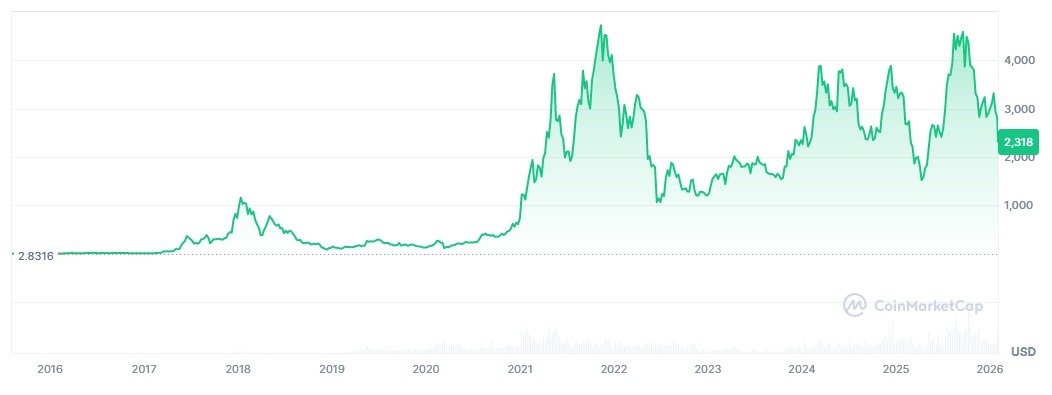
Ethereum (ETH) entered the market in mid-2015, starting as a niche blockchain project. In its earliest days, the price of ETH was very low, dropping to around $0.42 per coin in October 2015, which remains its all-time low.
In 2017, Ethereum gained significant attention, starting the year under $10 and climbing to over $300 by mid-year. The momentum continued, with ETH surpassing $1,000 in early 2018 and peaking at approximately $1,433 in January. Following this peak, the price declined sharply, ending 2018 at around $133.
Throughout 2019, Ethereum’s price remained relatively stable, fluctuating between $100 and $300. In 2020, the price began to increase, closing the year near $737. The upward trend accelerated in 2021, with ETH reaching an all-time high of approximately $4,891 in November. However, the price declined in 2022, ending the year around $1,200.
In 2023, the Ethereum price showed some growth, ending the year at around $2,200. The first half of 2024 saw further growth, with the price of ETH briefly surpassing $4,000 in March. This was followed by a correction, but in November the price began to rise again and in December it again breached $4,000 several times.
Following this, a deep correction began, during which the price fell below $1,500 in early April 2025. However, after mid-April the price started to recover. By late April 2025, Ethereum had rebounded above $1,800 and gradually strengthened through the following months. In June it hovered near $2,500, showing steady accumulation.
The rally accelerated during the summer, with ETH surpassing $4,000 in August and briefly touching around $4,945. Through September, prices remained mostly between $4,000 and $4,600.
October 2025 brought more volatility: ETH briefly rose above $4,700 early in the month before retreating toward $3,700 – $4,200. Late October and early November saw this range-bound behavior persist, with prices often oscillating between roughly $3,800 and $4,200 as bulls and bears battled for control.
In November 2025, the price of Ethereum gradually declined from its previous highs. After that, in December 2025 and January 2026, the price traded in the range of $2,800 to $3,300.
On January 29, a sharp collapse of the crypto market occurred, resulting in the price of ETH falling to the range of $2,300 – $2,450.
ETH price forecasts
Ethereum (ETH) technical analysis
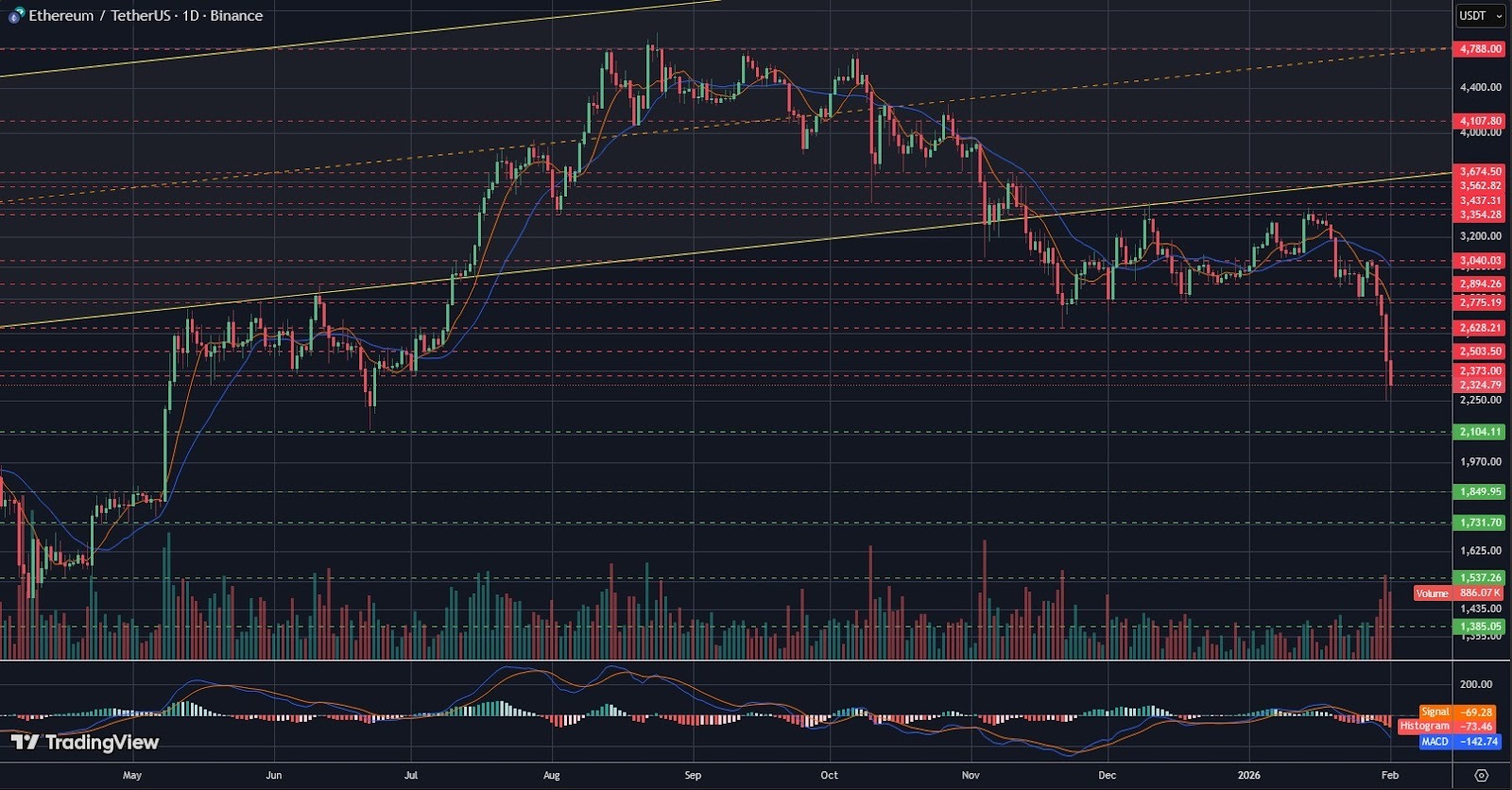
On January 29, the price of Ethereum began to fall sharply along with the rest of the cryptocurrency market, and this decline is still ongoing. Moving Averages, MACD and Parabolic SAR are all bearish. The RSI is in the oversold zone, indicating a possible rebound or slowdown in the decline. The daily trading volume is $37.81B which is -17.92% less than the previous day.
The nearest support levels are $2,100, $1,850 and $1,740. The nearest resistance levels are $2,370, $2,500 and $2,630.
Short-term ETH price prediction
The most likely scenario now is a further decline in prices to levels around $2,100 and possibly to around $1,850, after which there is a good chance of a reversal. Less likely, but still possible, is a rebound from current levels.
Medium-term ETH price prediction (early 2026)
Early 2026 is likely to be a consolidation phase for Ethereum. After ETH showed strong gains in 2025, the market may shift into a “cooldown” period with higher volatility and frequent pullbacks. Price direction will depend on the overall state of the crypto market, as well as whether institutional demand and real on-chain activity remain strong enough to absorb profit-taking.
Key drivers include Ethereum’s dominance in DeFi, stablecoins, and tokenized assets, alongside continued L2 growth and staking participation. Supportive network fundamentals could keep ETH resilient, but competition from other L1s and liquidity fragmentation across L2s may cap upside. Macro and geopolitical factors remain critical: improving liquidity and risk appetite could extend the uptrend, while hawkish policy shifts, recession fears, or geopolitical shocks may trigger risk-off selling across crypto.
In a base case scenario, ETH trades within a $2,400 to $3,400 range as the market stabilizes without entering full euphoria, with steady institutional participation, healthy L2 activity, and cautious Fed easing.
In an optimistic scenario strong liquidity and institutional inflows could push ETH toward the $4,500 to $6,200 range. This requires broader risk-on market conditions alongside improving technicals.
Conversely, a bearish scenario could pull ETH into the $1,500 to $2,200 range if macro headwinds intensify, combined with continued disappointing ETF flows and competitive pressure from alternative L1 networks.
Long-term ETH price prediction 2026-2030
Ethereum’s long-term price trajectory depends on the various factors described earlier in this article. One of the most important factors is whether Ethereum can withstand the growing competition from other platforms.
High price scenario
If Ethereum successfully executes its full roadmap, maintains its smart-contract ecosystem leadership, and benefits from a favorable macro environment (low rates, supportive regulatory framework, strong institutional inflows), then ETH can reach $10,000-$15,000 by 2030.
Moderate price scenario
In a balanced outcome where upgrades occur (though perhaps with some delay), competition is meaningful but not devastating, and macro conditions remain neutral, ETH might trade in the range of $5,000-$10,000 by 2030.
Low price scenario
If Ethereum faces significant setbacks (major competitor captures large market share, regulatory risk intensifies, network growth stalls), then ETH may be limited to $1,500-$3,000 by 2030.